Ever get the feeling we need to do this a bit differently?
Below is the script of a keynote speech given by Morgan Phillips in London on March 14th 2026 at the Climate and Nature Education Festival.
I should start by saying - without being too over dramatic - that the views expressed in this talk are my own and not necessarily those of any of the organisations I’m associated with.
The event booking page for today has a list of questions that we might explore here together.
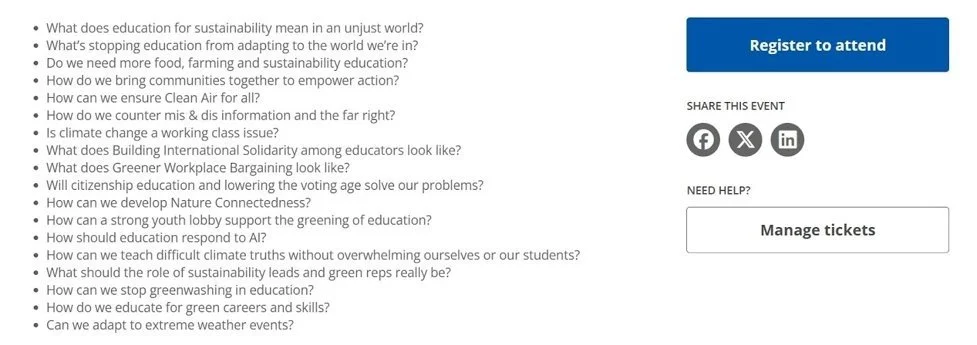
There are some great questions there - how can we develop nature connectedness? Can we adapt? What about AI? Is climate change a working class issue?
The next question on the page was this:
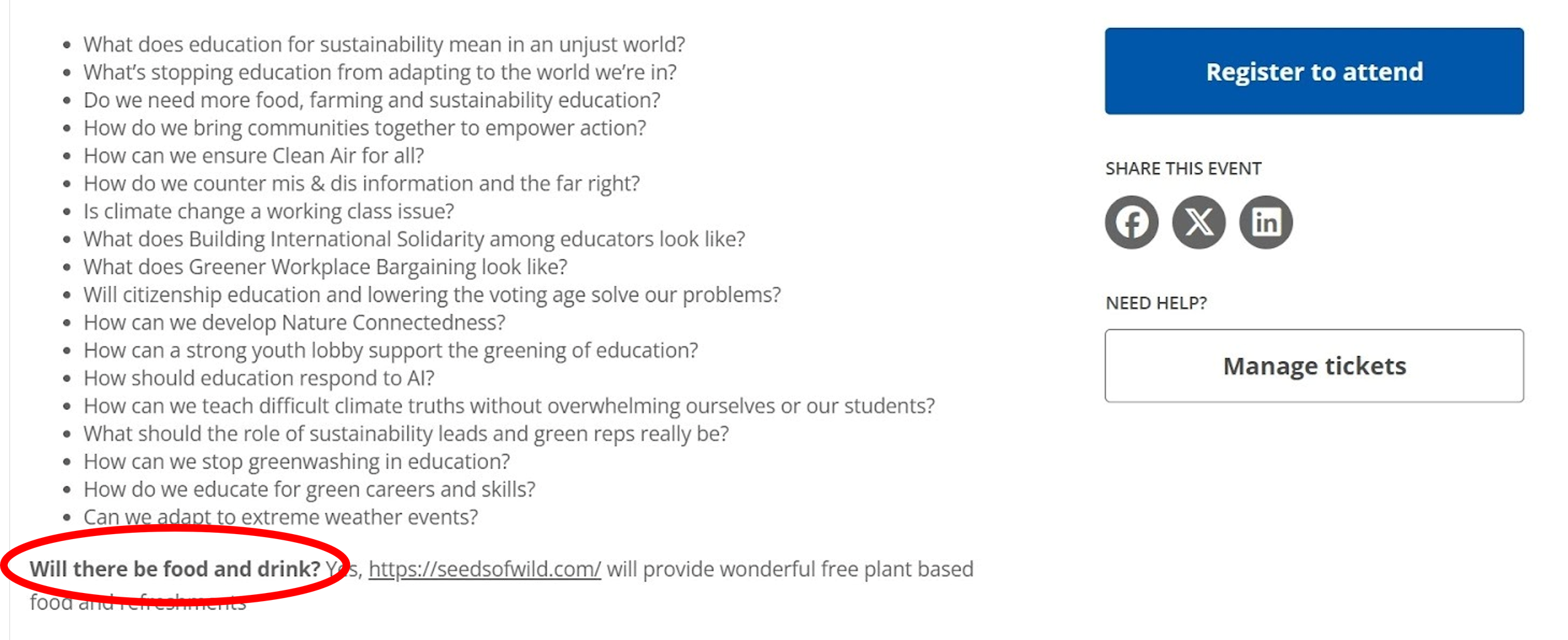
‘Will there be food and drink?’ Today, for us, yes there will be - thank you Seeds of Wild.
But, that’s THE question isn’t it? Will there be food and drink?
It is the sort of question I can imagine a ten year old asking:
10 year old: “Sir, you know if climate change gets really really bad, if all the forests burn down and the deserts get bigger and bigger, and all the ice melts…”
Sir: “Yes….”
10 year old: “If that happens Sir, will there be any food and drink? Will there be any food and drink when I’m a grown up?”
Sir: “Honestly kiddo, I don’t know, and the Government isn’t too sure either, climate change and ecological collapse is now - according to them - a national security risk.”
10 year old: “Oh.”
So that question, “will there be food and drink?”, is a profound one and not easy to answer.
And let’s not kid ourselves, there are families living very near here who are asking themselves this question. They’re asking if there will be food and drink next week, and climate change is a factor in that question. But there are also families near here who are not asking if there will be food and drink next week. They’re asking which restaurant they are going to eat and drink it in.
The financially wealthy can, for now, insulate themselves from the worst impacts of climate change. They can distance themselves physically and emotionally from it in ways that many less wealthy people can’t. Class matters when it comes to climate change. It is a class and justice issue.
—-
So… climate change and nature education, that’s what we’re here to talk about today.
I’m not going to give you a lecture on what the climate and nature crisis is. You wouldn’t be here if you didn’t know at least something about what is going on. But there is one thing I want to note. Have you seen this graph?:
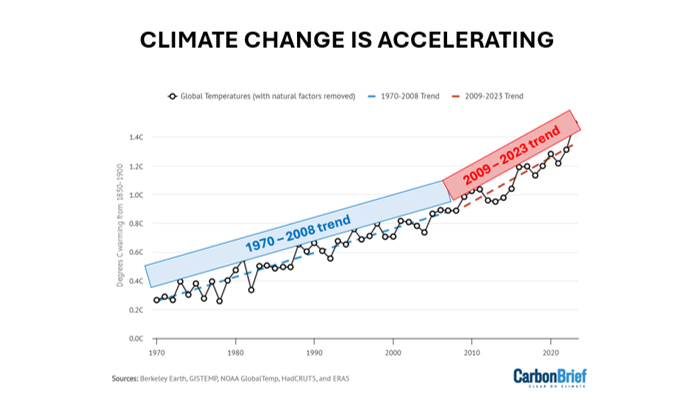
The scientific consensus around this has only just been reached. It is going under the radar a little bit - though it was good to see it reported in the Guardian recently. What it shows is quite game-changing really. It’s hard to take in, but we need to grapple with it. There has been a significant change of pace. It is getting warmer faster, much faster, than it used to. We’re not on the Circle Line anymore, we’re on the Elizabeth Line.
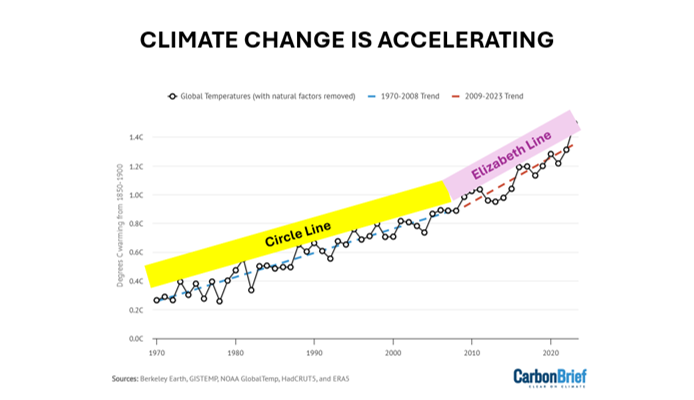
We’re getting to our destination faster. The brutal impacts of climate change will be here sooner than we thought. Climate change has changed. We are in a new reality.
However.
A lot of the approaches to environmental education and action that we are using in schools today, are the same ones we were using when we thought that we were still on a Circle line trajectory. Sadly, that world has gone, that’s isn’t the trajectory any more. We therefore need environmental education and action programmes that matches the new - Elizabeth line - reality.
I’m not sure we need the graphs though do we? I think a lot of us were sensing the change of pace already. We’ve observed it with our own eyes. Our bodies have felt it. This is a new paradigm; a scary new reality. And it is that fear - and the sense of urgency that goes with it - that feeds into our uncertainty about what to do. It is why there are so many unanswered questions.
We’re not sure what to do, but we know that we need to do something. So that’s what we do, something. Quite often though, it is the thing we’ve done before, only this time we resolve to do it with more effort, more urgency, and with more people.
We do it and hope that this time it will work. Well, it might. But, if what we did before didn’t cut it when climate change was at Circle line pace… it probably isn’t going to cut it now that we’re on the Elizabeth line.
There’s no judgement or blame from me here. It is hard to find the time, the capacity, the confidence, the funding, to come up with something new, and then develop it, test it, pilot it, and scale it up.
And so we stick to what we know, what our funders know, and what our bosses know. We stay in our comfort zones, or - because of how power works - their comfort zones. But the trouble with sticking to what you know, is that you get stuck while the world moves on around you. I think we’ve got a bit stuck.
Getting us unstuck is one of the things I’m hoping The Miracle Inn will help us do. Events like today’s conference will help us get unstuck too - there is no substitute for the sort of ‘ideas jamming’ we can do when we get together.
So, assuming we can get ourselves unstuck, and knowing that we need to be the most effective climate and nature educators we possibly can be…
What should we do? What should climate and nature education be in 2026 and beyond?
I have some thoughts on this. You guessed that right?! :)
What I want to argue today is that we need to acknowledge, collectively - as a movement - that we are in a new reality now, and that this requires us to:
Do what we are currently doing a bit differently
AND
Do some different things.
Are we, the people gathered here today - the teachers, practitioners, funders, bosses - prepared to acknowledge this? Are we prepared to step out of the comfort zone?
If we are - and I sense many of us are - I think we need to be prepared to:
Think critically about our own practice, and the practices we fund or enable.
Consider whether we are dealing with the root causes of the climate and nature crisis, or leaving them untouched?
Spend time together in forums like this, and in places like The Miracle Inn, developing and testing new approaches.
I spend far too much of my life doing these three things! I don’t have THE answer, but, like I said, I have some thoughts about what we should do and I have been fortunate enough to be able to put some of these thoughts into practice over the last few years - thank you Global Action Plan, for that opportunity.
But, I remain incredibly keen to continue to think critically and creatively, with others, to refine these ideas further, hence setting up The Miracle Inn, hence coming here today.
So, I am going to spend the rest of my talk setting out some ideas on what I think we, as climate and nature educators, should do in this new reality. These ideas are built upon three key assumptions:
Our young people are in, and are going further into, some very difficult times. The future looks scary and it is coming at them fast.
It will always be better for our young people to go into times like these with others, not on their own. Going into woods alone at night is frightening; going into them with a bunch of mates is less so. In fact, it might be quite thrilling.
Our young people stand more chance of surviving and maybe escaping the darkness ahead if they work together.
As I said a minute ago, if we acknowledge the need to do things a bit differently, and do some different things, then we need to consider whether we are tackling the roots of the crisis? So, let’s start there.
The roots of crisis are deep, very deep. Climate change is a symptom of a much bigger, much hairier set of problems. At the heart of them, is a problem that is growing, and that we’ve hidden away from for far too long.
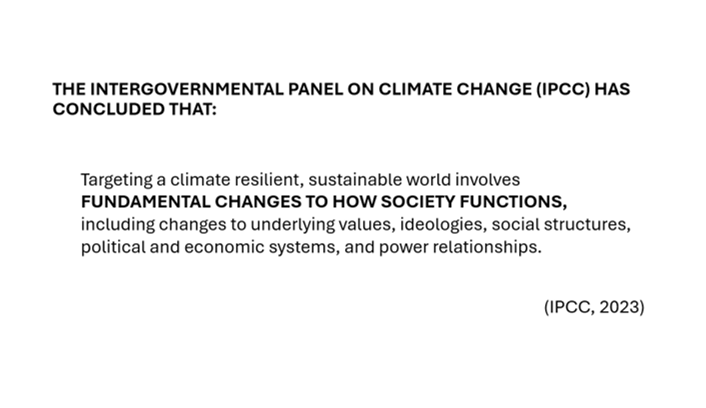
If we let it grow anymore, it is going to completely destroy our ability to come together – and we will need to come together – to create the ‘fundamental changes to how society functions’ that even a body as conservative as the IPCC is now saying are necessary.
At the core of the deeper problems is a very powerful idea: Individualism. Individualism, as an idea, goes way back, potentially to the middle ages. Arguments over what it means to be an individual can also be traced way back. Shakespeare explored it, as did many enlightenment and renaissance thinkers, Freud covered it too. What’s obvious though is that it was rich white men who got to be individuals first.
It was not until a lot lot later that a significant number of us began to feel liberated from the patriarchal, racist, supremacist, power structures that those men created.
Some of us felt this liberation sooner than others. Some of us feel it more fully than others to this day. None of us should take it for granted. Indeed, many people here, and many many more around the world are still fighting for liberation, for the right to be themselves. Racism, Supremacism, the Partriarchy; they all still need to be smashed.
Individualism, in the modern sense, started to emerge in the mid twentieth century. It was a positive, liberating force - not for all people - but for many. In the 1950s, especially in the United States, and then throughout the western world, people began to slowly free themselves from the rigid institutions and restrictive cultural norms of the past. They tried new ways of living, dressing, thinking, and relating. Artists, musicians, writers, architects, designers, started to experiment, and innovate, at a tremendous pace.
This continued through the 60s, 70s, 80s and 90s. Culture and technology exploded. As a result, each of those decades has its own specific identity in our memories and our imaginations. But over the last few decades - particularly since the turn of the century - individualism has morphed into hyper‑individualism.
A hyper‑individualist world is different. It is more lonely, more isolating, more desolate. As a result of the separateness it fosters, we collaborate less, imagine less, and create less that is genuinely new. In the same way that environmentalism has got a bit stuck, culture has got a bit stuck too.
Over these last few decades we - and by ‘we’ I mean people living in the Western world - have become less ‘creative actor’, more ‘passive consumer.’ We spend less and less time in groups, and more and more time on our own. And in this state - sweeping generalisation alert - we shop more. More than we need to, more than we used to, and more than most other countries.
This explains why eco footprints, in countries like the UK, are some of the highest in human history anywhere in the world, ever.
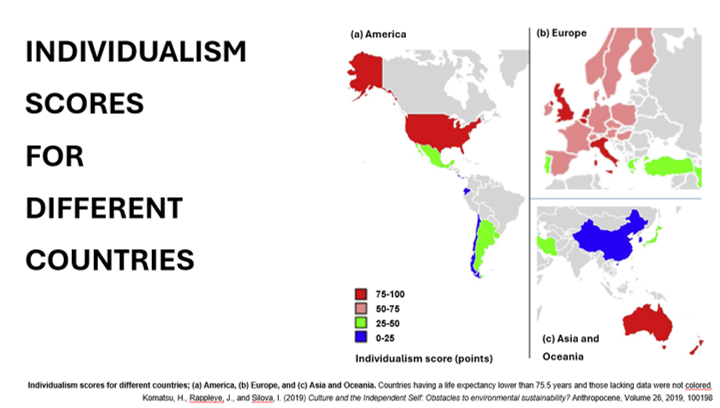
So, it is not likely a coincidence that countries with the highest levels of individualism are also the countries with the highest ecological footprints:
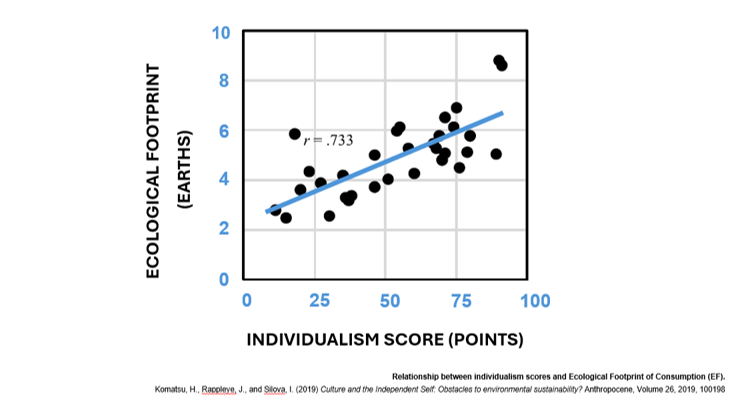
Hyper-individualism is doing two things:
It is making us consume more - it drives up carbon emissions.
But, it is also preventing us from coming together to change the system that sustains it - it drains our collective power.
Those are the two reasons why we need to do one thing:
Rein hyper-individualism in.
That should be our focus. The good news is that this is possible. Despite the grip it has on us, it is possible to rein hyper-individualism in. Why? Because the hyper-individualistic society that we have is not inevitable.
It is the direct result of political decisions made around about the time I was born. And, if the future holds open one exciting prospect, it is this: New, better, political decisions can be made.
Earlier on, I described what happened when individualism morphed in hyper-individualism. I’m now going to try to explain why this happened and why hyper-individualism therefore isn’t inevitable.
Many of you will be familiar with the story of The Lorax. In The Lorax, a character called the Once‑ler begins harvesting Truffula trees to make a product called a Thneed - a multifunctional piece of clothing or fabric that is marketed as essential, but is ultimately completely unnecessary.
The Lorax - who “speaks for the trees” - warns of the consequences of this new industry. But the Once‑ler, motivated by profit, continues to chop the trees down. Importantly, the citizens of Thneedville are not just passive observers in this - they participate too. They take the work that is on offer; they need jobs. So they chop the trees, make the Thneeds in the factory, market them, and sell them, and so on. Many of them also buy the Thneeds, they are fashionable items and a status symbol.
The story isn’t about a single greedy person. It is about a system that compels everyone - producers and consumers - to act in self‑interested ways, even if, deep down, many wouldn’t choose self-interest, and the destruction it creates, if there was an alternative way to be. Sadly, The Lorax doesn’t have a happy ending - not the book version anyway.
In the UK, in the late 1970s, early 1980s, when I was a toddler, a system like this started to form. It was a deliberate political project. Which means… we need to take a moment to consider the seismic impact that Margaret Thatcher had on who we are, who we think we are, and what we do.
Building on the ideas of economic thinkers like Friedrich Hayek and Milton Friedman, Thatcher - in partnership with Ronald Reagan - ushered in an era of neoliberal capitalism. It was a new system, a new set of socio-economic conditions. This was the political decision that set us off on the path to hyper-individualism.
Neoliberalism - whether you think it good or bad - was absolutely transformative. That was the plan. Thatcher and her allies wanted to reshape society. They did it by empowering markets, promoting competition, and reducing the role of the state. This was done through privatization, deregulation, and by taking on the unions.
She undoubtedly succeeded, and pretty much every Prime Minister since has continued the Neoliberal project. Neoliberal capitalism acts like the system in The Lorax. It embeds extraction, competition, and overconsumption - not because individuals necessarily value those things, but because the system rewards and compels those behaviours.
The Truffula forest wasn’t destroyed because the Once-ler hated trees. It was destroyed by economic incentives and a complete lack of regulation that allowed his initially small little enterprise to mushroom into an ecologically disastrous, behemoth.
In the same way, our planet is being destroyed by an economic system that demands profit and growth and pursues it at the expense of just about everything else: nature, climate, human rights, social cohesion.
Thatcher was Education Secretary when The Lorax was first published. I’m not sure if she ever read it, but she definitely understood how economic policies can shape behaviour, shape what we value, and ultimately - over time - shape who we are.
She was not unique in understanding this, but what was unique about her was how willing she was to be explicit about why she wanted to introduce the neoliberal economic policies that she did.
In an interview, in The Times, in 1981, two years into her first term, she famously said this: “Economics are the method; the object is to change the heart and soul.”
I’m going to quote Dr. James Davies here, he explained what Thatcher meant by this:
The kind of hearts and souls Thatcher wanted to fashion via her policies were entrepreneurial, self-reliant, hard working and economically productive. In fact, the kind of personality type she revered most of all, seemed to most closely match the contours of her own: she wasn’t that much interested in introspection, introversion and self-cultivation, but in extraversion, ambition and constant activity. She admired the battling sort, and believed that perpetual striving and busyness indicated a kind of higher species of living – something her economy would both encourage and reward. She had less imagination for the happy minutiae of everyday life, for more local ambitions, hobbies and affiliations – for the multitudes of little kindnesses upon which communities and societies are built. She was impressed by success, self-reliance and striving – by people who sacrificed everything to ‘better themselves’ (which for her mostly meant ascending the economic ladder).
Thatcher and her allies at the top of the Conservative Government had the power to shape who we are and they used it, unapologetically. They wanted us to be ‘rugged independent selves’, i.e. people who don’t rely on the support of others or the state. There has been a good deal of resistance to this over the years, but basically they got their way. It is quite outrageous when you think about it.
It was almost like Thatcher noted the rise of individualism in the 60s and 70s and said to voters: ‘Oh, you like having a bit of freedom and independence do you? How about you stand on your own two feet a bit more? How about we trim public services back a bit? You can manage without them. It’ll be good for you. You’ll be more self-reliant, more entrepreneurial, more like me.’
And ever since then, that’s what’s happened, cuts and cuts to public services, the NHS, education, care, transport, water, welfare. The support structures and the infrastructure that we rely on has been chipped away at, creating an ever increasing need to fend for oneself. This has put us in fierce competition with the planet and each other, which has made us busier and busier and, in turn, gradually fragmented us as a society and detached us from nature.
Neoliberalism has slowly eroded the support structures we all need if we want to be the best version of ourselves individually, and collectively.
The individualism, which was lovely and brilliant when it started, was lovely and brilliant because it co-existed with collaboration, community, and decent public services.
The ying had a yang. What we have now is a ying without a yang.
The yang - community and public services - have been eroded away by decades of neoliberalism. Take that away and what do you get? Isolated individuals, not connected individuals. Individualism without collectivism - a hyper-individualist society; and a hyper-individualist culture. There is a lot more to it than that, but that’s a quick summary of where hyper-individualism has come from.
What does all this mean for climate and nature education, and for environmentalism more broadly?
It means that we need to remember that climate change is accelerating, that individualistic societies have the highest carbon footprints, and that the IPCC are calling for fundamental changes to how society functions. We need to remember all that, and that the work this moment therefore demands of us is culture shifting work. We need to work to rein hyper-individualism in.
So, how do we do that? Well that is what is being figured out - and pre-figured - in some corners of the environmental movement right now. And it is what we will be exploring and testing at, and through, The Miracle Inn.
There are two categories of work emerging. You can do both.
First, there are efforts to shine a light on hyper-individualism so that more people are aware of what it is, where it came from, and why it is so problematic. These efforts are powerful in their own right, they help us to see that hyper-individualism, and all the problems it creates, are not inevitable.
What does this look like in practice, in our education settings? Well, you could:
Read The Lorax with your students.
Spend time examining the origins of neoliberal economics, the agenda behind it, and the impact it has had.
Critique how ‘rugged individualism’ and high consumption lifestyles are glorified and promoted, in many different ways, by brands, politicians, films, songs, influencers, adverts, TV shows.
So that’s one side of the coin, on the other is something more foundational. The best way to counter hyper-individualist culture is to be an antidote to it. That means nurturing an alternative.
I’ve mentioned collectivism a couple of times, but I don’t think collectivism is the alternative. Hyper-collectivism is as problematic as hyper-individualism. The alternative, I think, is interdependence.
I’m not being theoretical here, a Movement for Interdependence is emerging right now.
There are people, organisations, and teachers who are helping us rediscover ourselves not as isolated consumers, but as connected beings. When we engage with them we begin to let go of the notion that we need to be a “rugged independent self.” Instead, we start embracing the idea that we are best when we are a society of interdependent selves.
To have an interdependent sense of self is to feel connected to others and to the more‑than‑human world… while still being yourself. Cara Gardenswartz describes it well:
Interdependence represents the delicate dance of mutual reliance and support within relationships. Unlike the notion of rugged independence, interdependence acknowledges the inherent interconnectedness of individuals and celebrates the strength found in collaboration. In interdependent relationships, partners embrace their vulnerabilities, share responsibilities, and draw strength from each other's unique qualities. Through open communication and genuine reciprocity, they cultivate a sense of belonging and unity while maintaining their individual identities.
Basically, this is relationship advice. It suggests that we do not have to give up our individuality to live with others - we can maintain our unique identities and support one another. The Movement for Interdependence takes this idea further, moving from personal relationships to societal and ecological relationships.
It does not ask us to sacrifice ourselves entirely to a cause like climate change; rather, it invites us to care for self, and bigger-than-self, simultaneously. It is a balancing act. Ying and yang.
Can teachers be part of this movement for interdependence? Absolutely, and they are. Schools and teachers can, and do ‘acknowledge the inherent interconnectedness of individuals and celebrate the strength found in collaboration’. OK, I know that this is very easy for me to say, the English education system isn’t geared towards this, but it is possible. It is possible to nurture interdependence and still get a decent Ofsted or Estyn report.
How is it done? How are educators being the antidote? Schools are experimenting with:
Experiential, nature‑embedded learning - things like Forest School,
Community‑linked project based learning - things like Good Life Schools at Global Action Plan
Curricula that emphasise collective problem‑solving,
Developing young people’s relational understanding and their ability to relate.
Nurturing a cooperative rather than competitive culture in and around school.
These are all things that are already happening in schools in England, but not everywhere. These approaches help learners to see themselves not as separate from the world around them, but as part of it.
It is through this sort of education that young people come to see themselves as interdependent, rather than independent selves. That is culture shifting stuff.
Can we do more of it?…
We face a profound moment in history. Neoliberalism has given birth to hyper-individualism and hyper-individualism is causing so much harm. Climate change is accelerating, nature loss is going the same way. To tackle and cope with climate change we can’t simply tweak neoliberal capitalism to make it ‘greener’. We need to consider what will come after it, because it won’t last forever.
But something new is not going to magically just emerge, it is going to take a mass movement, built on strong bonds of trust, to generate the political will needed to usher a new socio-economic system in.
By bringing us together, entangling us with each other and the planet, the Movement for Interdependence - which includes many environmentalists and educators already - is building the connections that nurture those bonds of trust that we need.
If we nurture a generation of young people who see themselves as interdependent, rather than independent beings, we might just plant the seeds for a society that is just, sustainable, and thriving - a society very different from the barren forest left behind in The Lorax.
I’ll leave you by addressing one final question that might be going round in your head:
What if it's already too late? What if we can't avoid collapse? Is it still worth trying to put an end to hyper-individualism?
Well, yes. If we still have hyper-individualism, the pace of climate change isn’t going to change. If anything, the curve is going to get steeper and steeper. So, my advice is this:
Whether or not we're headed for collapse, we should still strive to nurture connectedness, togetherness, and interdependence. We should still seek to build those bonds of trust, rein hyper-individualism in, and build social capital.
If this effort results in the emergence of a new, ecologically literate, just, and fair, economic system, great. But if it doesn't, it won’t be a wasted effort. Our young people will have come together a bit more, become a bit more entangled, and more interdependent in spirit and in practice.
And in this togetherness - when they are in those dark woods - they will be more resilient, more adaptive, and more able to ensure that…. there will be food and drink.
Thank you.
If you would like to learn more about The Miracle Inn, please sign up to the e-newsletter to help us get it off the ground. We plan to launch in spring 2026.
